
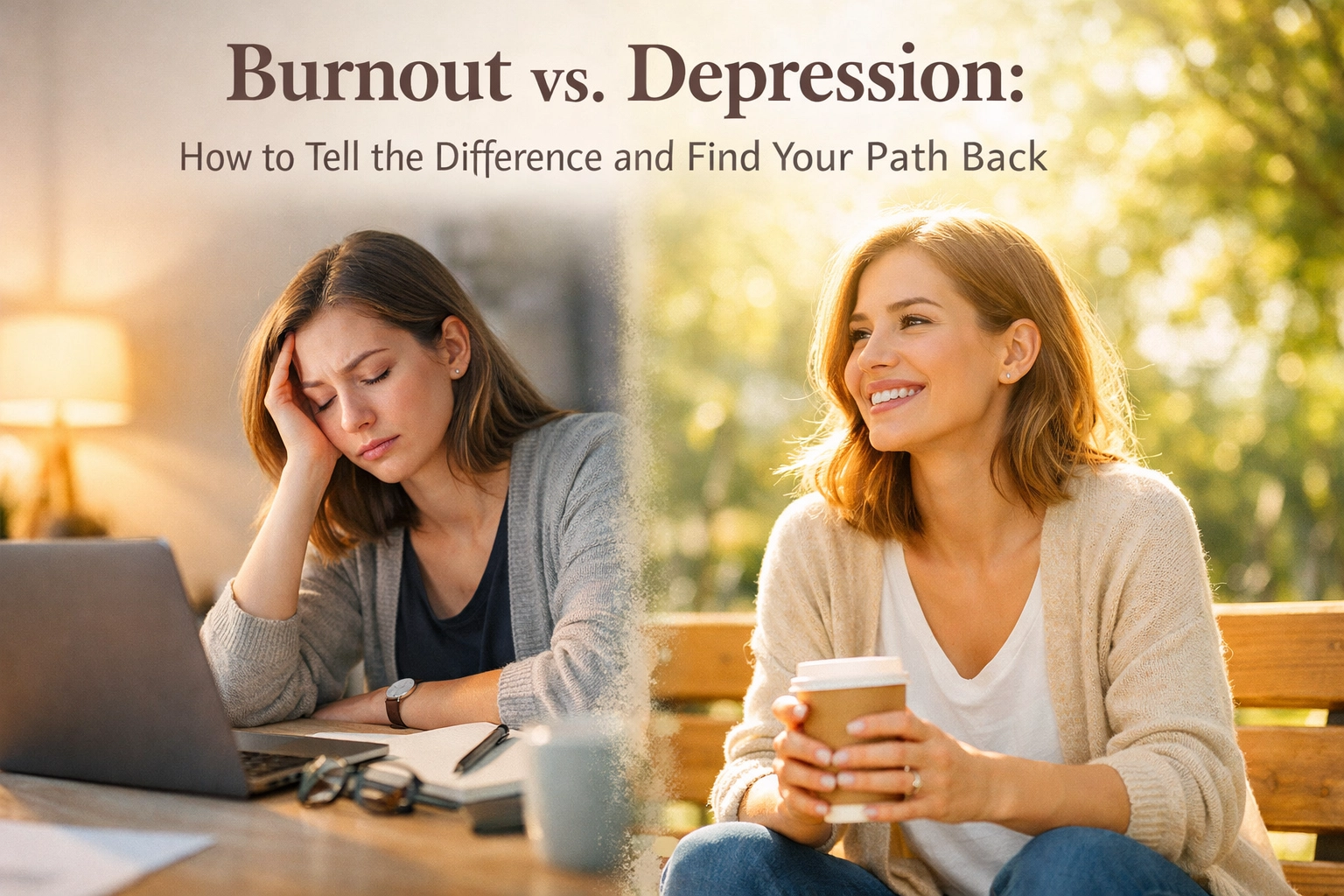
Have you ever woken up, looked at your to-do list, and felt a weight so heavy it was hard to even sit up? Maybe you’ve found yourself staring at your laptop screen for twenty minutes without typing a single word, or perhaps you’ve noticed that the things that used to bring you joy, like meeting a friend for coffee or going for a walk, now just feel like another chore.
If you’re feeling "done," "empty," or just plain "stuck," you aren’t alone. We see you, and we hear you.
At The Counseling Place, we talk to so many people who are trying to figure out if they are just really, really tired from work (burnout) or if something deeper is going on (depression). Because the symptoms can look so similar, it’s easy to get them confused. But understanding the difference is the first step toward feeling like yourself again.
Let’s walk through this together and look at how these two experiences differ, how they overlap, and how you can start your journey back to a place of peace.
What Does Burnout Actually Feel Like?
We live in a culture that often prizes "the grind" above everything else. We’re taught that being busy is a badge of honor. But our bodies and minds weren't designed to be "on" 24/7.
Burnout is essentially a state of emotional, physical, and mental exhaustion caused by excessive and prolonged stress. It usually happens when you feel overwhelmed, emotionally drained, and unable to meet constant demands.
The biggest hallmark of burnout is that it is situational. It’s usually tied to a specific area of your life, most often your job, but it can also stem from caregiving or even high-stress volunteering.
Signs you might be dealing with burnout:
- The Sunday Scaries: You feel a deep sense of dread on Sunday evening (or whenever your "weekend" ends) because you can't face the coming week.
- Cynicism and Detachment: You find yourself feeling increasingly negative or "numb" about your work. You might start to feel like nothing you do matters or that your coworkers are all irritating.
- Physical Fatigue: You’re tired in a way that sleep doesn't seem to fix. You might have frequent headaches or muscle tension.
- Reduced Efficacy: You feel like you aren’t doing a good job anymore. Tasks that used to take an hour now take three, and you feel a sense of "brain fog" whenever you try to focus.
- Intact Self-Esteem: Generally, with burnout, you still like yourself, you just hate your situation. You might think, "I'm great, but this job is destroying me."
Understanding Depression: The Pervasive Cloud
While burnout is usually linked to a specific cause, depression is a mental health condition that is pervasive. It doesn't stay in the "work" box; it spills over into every single corner of your life.
If burnout is like being a car that has run out of gas, depression is like having a broken engine. It doesn't matter where you're trying to drive; the car just won't go. Depression colors the way you see yourself, the way you see the world, and the way you see the future.
Signs you might be dealing with depression:
- Persistent Sadness or Low Mood: This isn't just a "bad day." It's a feeling of "emptiness" or "heaviness" that lasts for most of the day, nearly every day, for at least two weeks.
- Loss of Interest (Anhedonia): You no longer care about hobbies, sex, food, or friends. Even the things you used to love feel "gray."
- Feelings of Worthlessness or Guilt: This is a major differentiator. Unlike burnout, depression often involves a direct hit to your self-esteem. You might feel like a failure, or like you’re a burden to the people around you.
- Changes in Sleep and Appetite: You might be sleeping all the time, or you might not be able to sleep at all. Similarly, you might lose your appetite entirely or find yourself "numb-eating" for comfort.
- Hopelessness: You have a hard time imagining that things will ever get better. You feel stuck in a tunnel with no light at the end.

The "Vacation Test": A Simple Way to Tell
One of the most practical ways to distinguish between the two is what we like to call the "Vacation Test."
If you were to take a full week off, no emails, no chores, no "to-do" lists, and go somewhere relaxing, how would you feel?
- If it's Burnout: After a few days of rest and disconnection, you’d likely start to feel like your old self again. Your energy returns, your mood lifts, and you start to feel interested in the world. However, the dread might return the second you pull back into your office parking lot.
- If it's Depression: A vacation might be a nice change of scenery, but the "heaviness" travels with you. You might find yourself sitting on a beautiful beach feeling just as sad or empty as you did at your desk. Rest alone doesn't "fix" it because the root isn't just situational stress, it's a deeper psychological or biological state.
Can You Have Both?
The short answer is: Yes.
Chronic, unaddressed burnout is one of the leading runways into depression. When you are under high stress for too long, your body's stress-response system (the fight-or-flight mechanism) eventually gets worn out. This can lead to a "shut down" phase that mirrors or triggers a depressive episode.
This is why it is so important to listen to your body early. Taking action when you feel "burnt out" can often prevent you from slipping into a deeper clinical depression.
Why Both Are Valid Reasons for Support
Sometimes people think, "Oh, it's just burnout, I shouldn't complain," or "I'm just stressed, I don't need therapy."
But here’s the truth: You don't need to be "in a crisis" to deserve support.
Whether it is burnout or depression, you are experiencing a loss of your quality of life. You deserve to feel joy. You deserve to feel capable. You deserve to wake up without a pit in your stomach.
Therapy is a wonderful place to "unpack" these feelings. Together, we can:
- Identify the Root: Pinpoint exactly where the stress is coming from.
- Set Boundaries: Learn how to say "no" without the guilt.
- Rebuild Self-Esteem: Challenge the "inner critic" that tells you you aren't enough.
- Develop Coping Tools: Create a "toolbox" of strategies to manage stress before it becomes overwhelming.
Your Path Back
Healing isn't about "snapping out of it." It’s about taking small, gentle steps toward growth. Here are a few ways to start:
- Acknowledge It: Just naming what you are feeling, "I am burnt out" or "I think I might be depressed", takes some of the power away from the feeling.
- Audit Your Energy: Look at your week. Where is your energy going? Are there things you can outsource, delay, or simply stop doing?
- Prioritize the Basics: We know it sounds cliché, but drinking water, getting five minutes of sunlight, and moving your body slightly can help regulate your nervous system.
- Connect with a Professional: You don't have to navigate this journey alone. It is our privilege and honor to walk alongside you.
You Deserve to Feel Better
If you’re feeling like you’re just going through the motions, please know that it doesn't have to stay this way. There is a path back to the "you" that feels vibrant and engaged.
At The Counseling Place, we offer a warm, friendly environment where you can explore these feelings without judgment. We specialize in helping people navigate the complexities of modern stress, career burnout, and clinical depression.
Take the first step today. You can learn more about our services and book a session by visiting us at www.counselinglonetree.com.
A Note on Safety:
If you are in immediate distress or having thoughts of self-harm, please reach out for help right away. You can call or text 988 to reach the Suicide & Crisis Lifeline in the US and Canada, available 24/7. Your life matters.
Disclaimer:
The information in this blog post is for educational and informational purposes only and is not a substitute for professional medical advice, diagnosis, or treatment. Always seek the advice of your physician or other qualified health provider with any questions you may have regarding a medical or mental health condition.